
How to Eliminate Personal Debt Fast in 2026: A Step-by-Step Strategy That Actually Works
Learn how to eliminate personal debt fast using proven strategies that work in 2026. Discover step-by-step debt payoff methods and how the Debt Map Sprint System helps you become debt-free faster.
DEBT MANAGEMENT
ProsperNexus
3/21/20265 min read
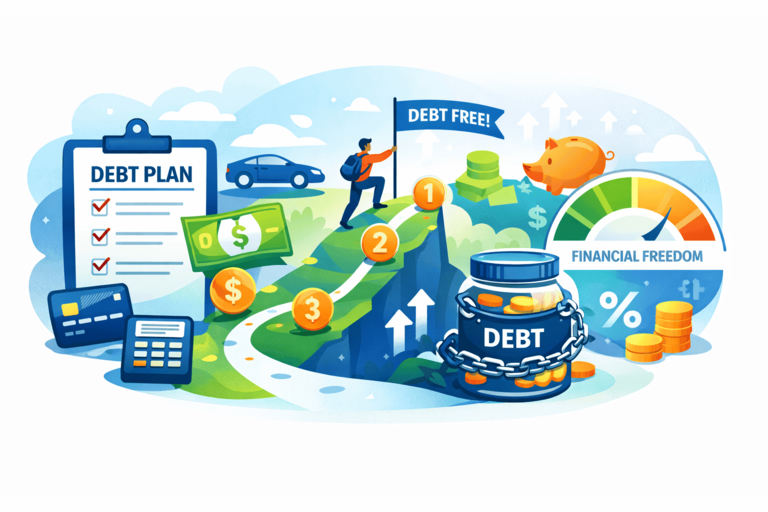
How to Eliminate Personal Debt Fast in 2026: A Step-by-Step Strategy That Actually Works
Why Personal Debt Elimination Is the First Step Toward Financial Freedom
If you’ve ever felt like your paycheck disappears before the month even begins, you’re not alone.
Millions of people are trying to figure out how to eliminate personal debt while juggling rising living costs, interest rates, and everyday expenses. Credit cards, personal loans, buy-now-pay-later services, and unexpected bills quietly stack up until suddenly debt becomes a permanent background stress in your life.
Here’s the truth most financial blogs don’t tell you:
Debt doesn’t disappear because you try harder.
Debt disappears because you follow a system.
That’s why the most successful debt-free stories don’t rely on motivation alone. They rely on structure, clarity, and momentum. When you understand exactly where your money is going and exactly how your payoff timeline works, everything changes.
This guide walks you through a proven personal debt elimination strategy used by thousands of people building long-term financial stability — and it introduces a structured method called the Debt Map Sprint System, designed specifically to accelerate your payoff timeline.
Step 1: Understand Exactly How Much Debt You Really Have
Most people underestimate their debt total by 20–40%.
Not intentionally.
But because debt hides in multiple places:
credit cards
personal loans
car loans
store financing
subscription balances
buy-now-pay-later apps
unpaid tax obligations
family borrowing arrangements
Before you eliminate debt, you must map it.
Create a simple debt inventory list:
Debt TypeBalanceInterest RateMinimum PaymentCredit Card$%$Loan$%$BNPL$%$
This becomes your Debt Map — the foundation of your payoff strategy.
Inside the Debt Map Sprint System, this mapping step alone helps most people reduce repayment time dramatically because clarity removes guesswork and hesitation.
When you see the full picture, you stop reacting to debt and start controlling it.
Step 2: Stop the Debt Cycle Before You Try to Pay It Off
This is the mistake most people make.
They try to pay off debt while still creating new debt.
That’s like trying to empty a bathtub while the tap is still running.
Before accelerating repayment:
Pause new borrowing where possible.
That includes:
impulse credit purchases
unnecessary upgrades
lifestyle financing
short-term convenience debt
This step isn’t about restriction.
It’s about momentum protection.
Because every new dollar borrowed delays your debt-free date.
One principle inside the Debt Map Sprint System focuses on what’s called interest-leak prevention, helping you identify the hidden spending behaviors that silently extend your payoff timeline.
Most people don’t need more income first.
They need fewer financial leaks.
Step 3: Choose the Right Debt Payoff Strategy (Most People Choose the Wrong One)
There are two famous methods for eliminating personal debt:
Debt Snowball Method
Pay smallest balances first.
Benefits:
quick wins
motivation boost
visible progress fast
Best for: people who feel overwhelmed by multiple accounts
Debt Avalanche Method
Pay highest interest debts first.
Benefits:
mathematically fastest strategy
lowest long-term interest cost
strongest long-term wealth impact
Best for:
people focused on efficiency over emotion
Here’s what most blogs miss:
Neither strategy is complete on its own.
The fastest debt elimination plans combine psychology + math.
That hybrid approach is exactly what the Debt Map Sprint System is designed to do — creating a personalized payoff route instead of a generic template.
Because your debt structure is unique.
Your plan should be too.
Step 4: Build a Debt Payoff Timeline (Your Brain Needs One)
Motivation increases when timelines become visible.
Instead of saying:
“I want to become debt-free someday.”
You start saying:
“I will eliminate this credit card in 9 weeks.”
That’s powerful.
Research shows people stick to financial plans longer when they can see milestone checkpoints ahead.
Create milestones like:
Month 1: Remove smallest balance
Month 3: Remove first high-interest account
Month 6: Eliminate 25% total debt
Month 12: Remove 50%
Inside structured elimination systems like the Debt Map Sprint System, this timeline becomes visual and trackable — which dramatically improves completion rates.
Because vague goals create hesitation.
Mapped goals create action.
Step 5: Find Hidden Money Already Inside Your Budget
Most people don’t need a second job to eliminate debt faster.
They need a smarter map of existing cash flow.
Here are overlooked sources:
unused subscriptions
insurance overpayments
unused memberships
duplicate services
bank fee leakage
impulse micro-spending
Even recovering $8 per day creates:
$240 per month
$2,880 per year
That alone eliminates an entire credit card for many households.
Debt elimination is rarely about sacrifice.
It’s about redirection.
Step 6: Use the “Sprint Strategy” Instead of Long Payoff Plans
Traditional debt payoff advice says:
“Take 5–7 years.”
That timeline destroys motivation.
Instead, sprint planning works better.
A sprint is:
short
focused
measurable
temporary
intense
Example:
8-week payoff sprint
12-week credit card elimination cycle
90-day balance removal target
The Debt Map Sprint System uses sprint psychology instead of long-term pressure, helping people create fast visible wins early in the process.
And those wins compound.
Momentum creates discipline faster than willpower ever will.
Step 7: Protect Yourself From Interest Acceleration
Interest is the silent enemy of debt elimination.
Here’s what many people don’t realize:
Minimum payments are designed to keep you in debt longer.
Example:
$5,000 credit card
18% interest
Minimum payments only
Payoff time:
10+ years
Same balance with structured acceleration:
12–18 months
That difference equals thousands saved.
Inside structured mapping frameworks like the Debt Map Sprint System, interest stacking becomes visible — which helps people shorten payoff timelines dramatically.
Visibility changes behavior.
Behavior changes outcomes.
Step 8: Automate Your Debt Elimination Plan
Automation removes decision fatigue.
Set:
automatic transfers
scheduled extra payments
paycheck splits
weekly micro-payments
Weekly payments outperform monthly payments psychologically and mathematically.
Example:
$200 monthly payment vs
$50 weekly payments
Weekly payments reduce interest accumulation faster and increase consistency.
Automation transforms intention into execution.
Step 9: Avoid the Motivation Trap That Keeps People in Debt
Most people think:
“I just need more discipline.”
They don’t.
They need:
clarity
structure
visibility
progress markers
Motivation fades.
Systems don’t.
That’s exactly why structured elimination frameworks outperform self-designed repayment attempts.
If you’ve tried before and stopped halfway, it wasn’t a failure.
It was missing infrastructure.
Step 10: Replace Debt Anxiety With Financial Direction
Debt doesn’t just affect money.
It affects:
sleep
confidence
relationships
career decisions
future planning
Removing debt creates breathing room in every area of life.
People often report:
better decision making
reduced stress
higher savings rates
stronger long-term investing habits
Debt elimination isn’t restriction.
It’s capacity creation.
Why Most Debt Payoff Plans Fail Without a Map
Imagine driving across a country without navigation.
Possible?
Yes.
Efficient?
No.
Repeatable?
Definitely not.
That’s why structured payoff frameworks outperform random repayment attempts.
The Debt Map Sprint System exists specifically to solve this gap.
Instead of guessing your payoff order, timeline, and strategy, it gives you:
a personalized debt elimination roadmap
a sprint-based payoff accelerator
interest-reduction visibility tools
momentum tracking checkpoints
If you're serious about becoming debt-free faster, this is where many readers choose to begin:
👉 Start your structured payoff plan here: Debt Map Sprint System
How Long Does Personal Debt Elimination Actually Take?
Typical results vary:
Light consumer debt:
3–6 months
Moderate debt:
6–18 months
Heavy structured debt:
18–36 months
But here’s what matters:
People using mapped payoff systems finish dramatically faster than people using minimum-payment strategies alone.
Speed comes from clarity.
What Happens After You Eliminate Debt?
Something powerful shifts.
Money stops disappearing into the past.
It starts building your future.
Most people transition next into:
emergency savings
investing
retirement acceleration
property ownership
side-income building
Debt elimination is step one of wealth creation.
Not the final step.
Your Next Step Toward Becoming Debt-Free
If you’ve been trying to eliminate personal debt but feel stuck, overwhelmed, or unsure where to begin, the solution usually isn’t more effort.
It’s a better plan.
The Debt Map Sprint System gives you the exact framework used by people who want a faster, clearer path toward becoming debt-free.
Instead of guessing what to pay first or how long it will take, you’ll build a structured elimination roadmap designed around your situation.
👉 Build your personal payoff roadmap here: Debt Map Sprint System
Because becoming debt-free isn’t about working harder.
It’s about working with a map.